Know before your customers do
Uptimr watches your websites, APIs and servers around the clock, alerts your team the second something breaks, and keeps everyone else informed with a status page you actually want to share.
No credit card required · 5 10 monitors free forever
15s
Fastest check interval
4
Check types: HTTP, keyword, ping, port
6
Alert channels per notification route
90s
Freshness window before a node or system is marked offline
From first check to resolved incident — automatically
Uptimr runs the whole loop for you: checking, confirming, alerting and keeping your status page up to date. Here is what happens behind the scenes.
-
1
Add what matters
Enter a URL, host or port and pick a check type — HTTP, keyword, ping, port or a heartbeat for your cron jobs. No software to install for any of these.
-
2
Checked around the globe
Worker nodes in Europe, North America and Asia check your service on a fixed interval and report status and response time back to Uptimr.
-
3
Confirmed, not guessed
A failed check is held back until a second node confirms it. Only then does Uptimr open an incident — so one flaky network route never wakes you up.
-
4
Everyone knows instantly
Your notification routes fan out to email, chat, voice and webhooks, and your status page switches to an outage. Once the service recovers, it all resolves itself.
Watch an outage unfold
This is a simulated incident, played in real time: a service fails, a second location confirms it, alerts go out and the status page follows — then everything resolves on its own once it’s back.
- 1 Every check lands on the timeline with its status and response time.
- 2 A single failure is only a warning until another node confirms it.
- 3 Alerts and status page updates happen without anyone lifting a finger.
api.example.com
HTTP · EU · NA · Asia
Response
— ms
Recent checks
Event log
Your status page
Catch outages before your customers report them
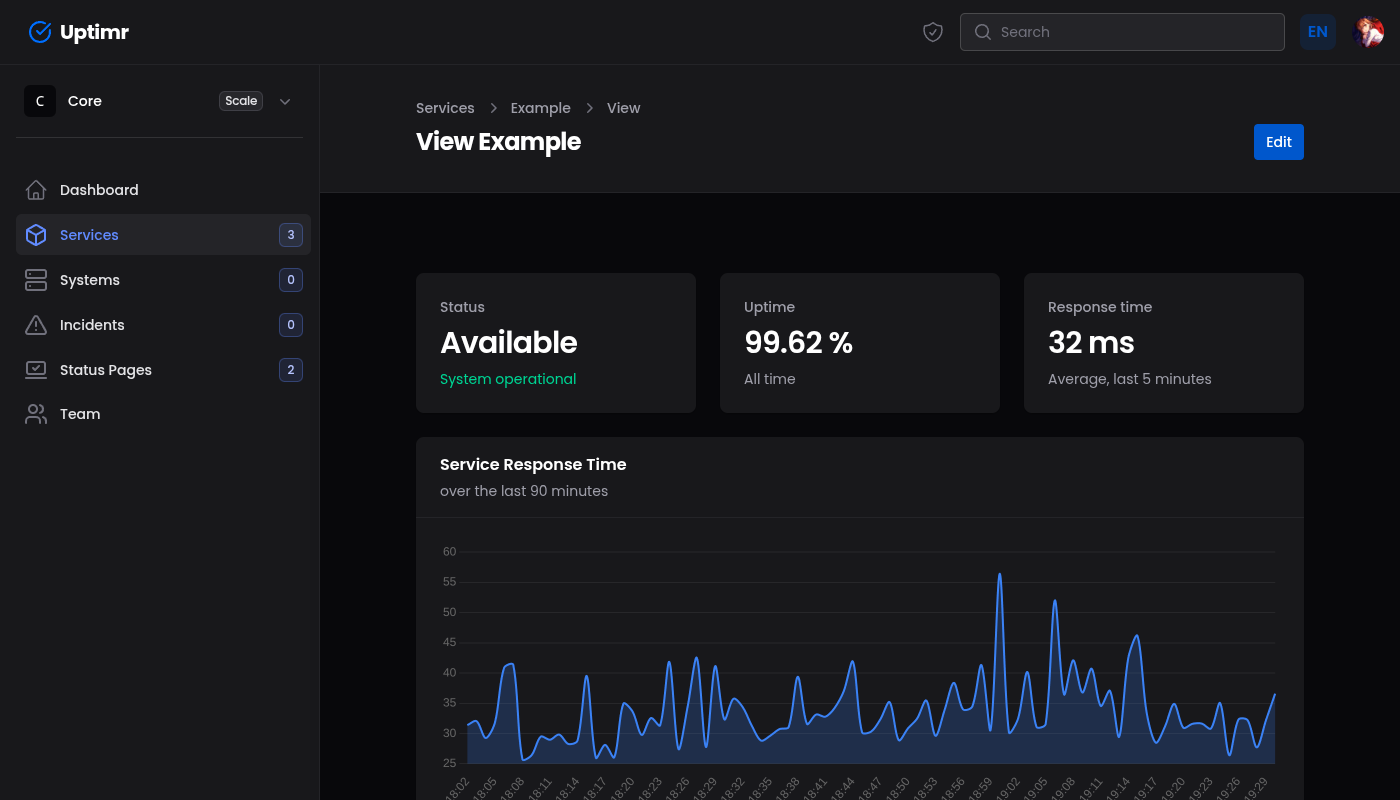
Add a service in seconds and Uptimr checks it around the clock — HTTP endpoints, keyword matches, raw ports and ping — from as many worker locations as your plan allows.
- HTTP, keyword, ping and port checks for websites, APIs and any TCP service.
- Checks run from multiple independent locations so a single network hiccup never causes a false alert.
- Check frequency down to every 60 seconds, with configurable degraded and down response-time thresholds.
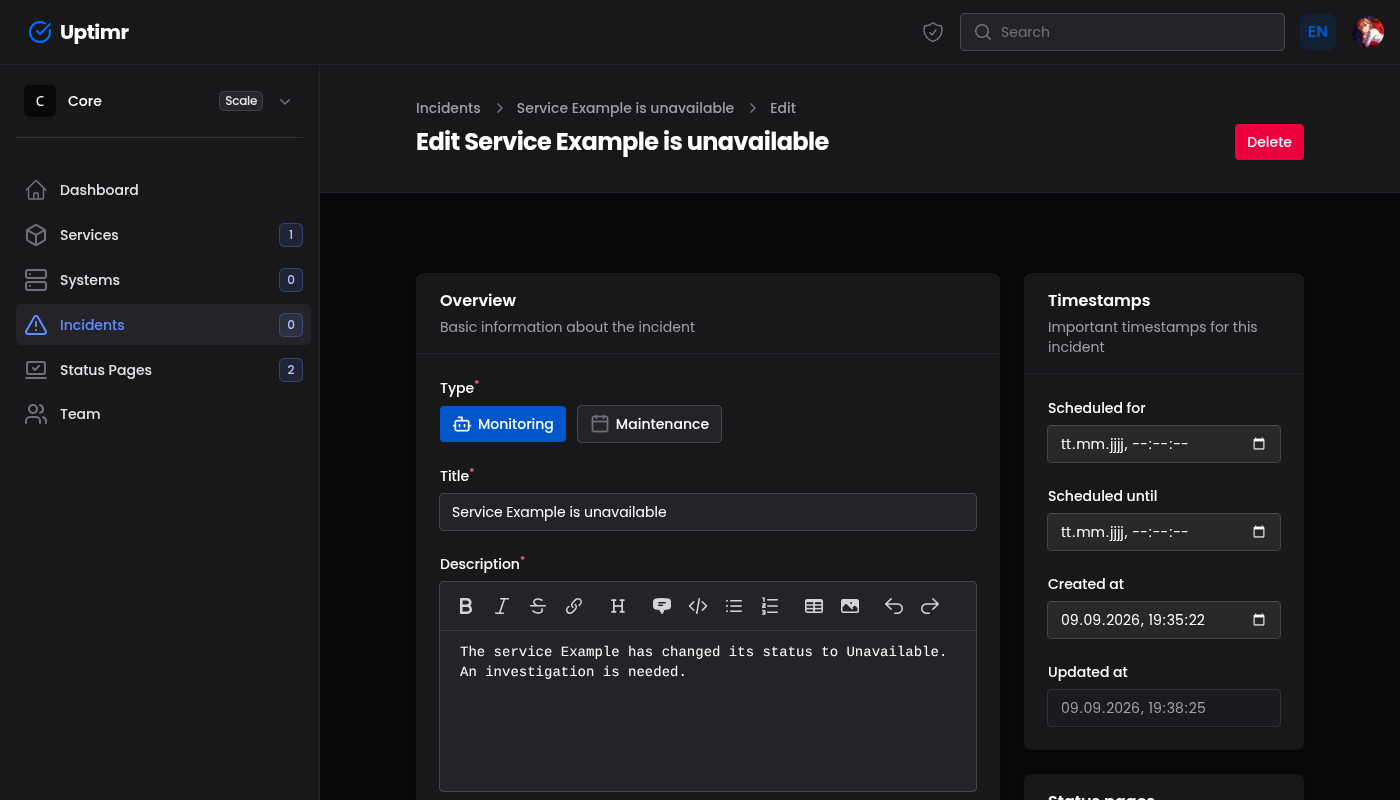
- Incidents open and resolve automatically as a service goes down and recovers.
See what’s happening inside your own servers
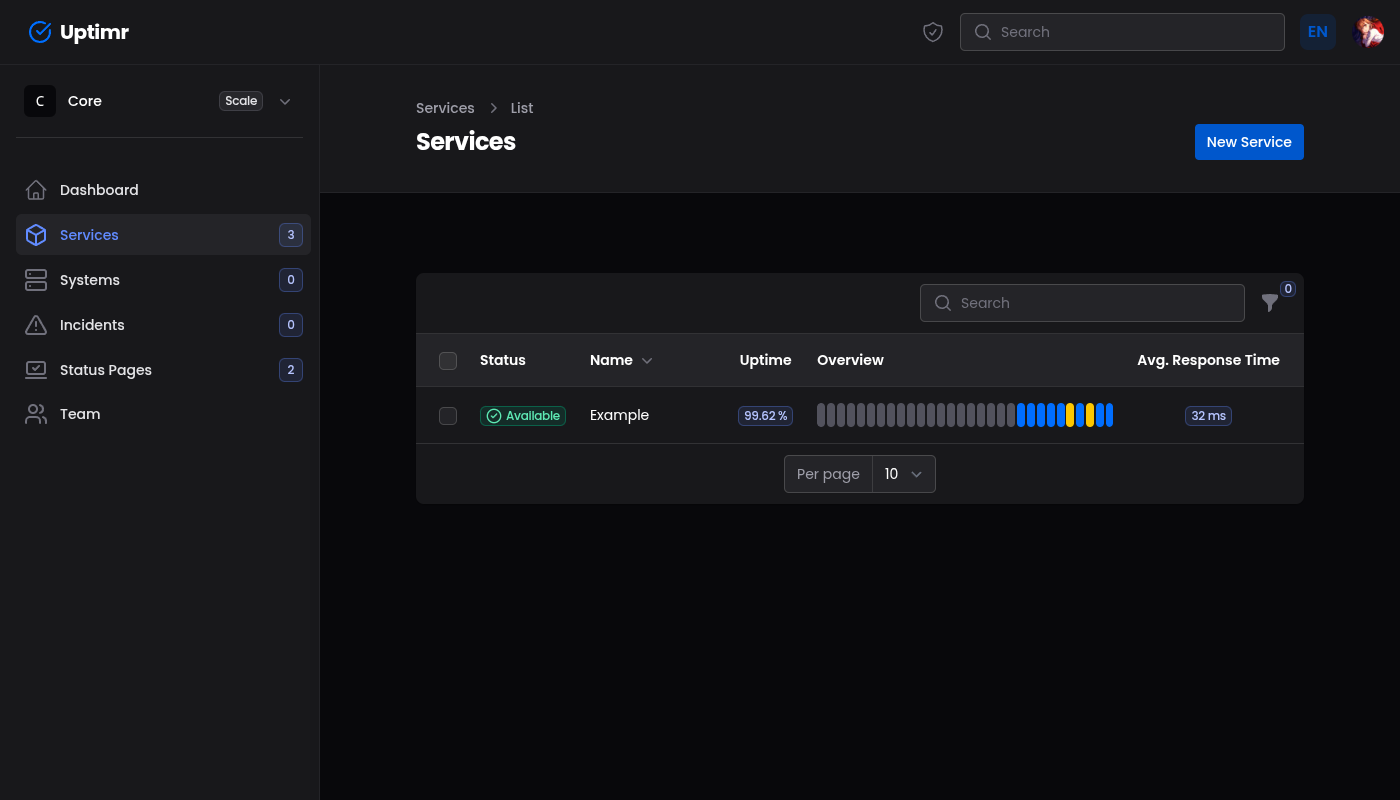
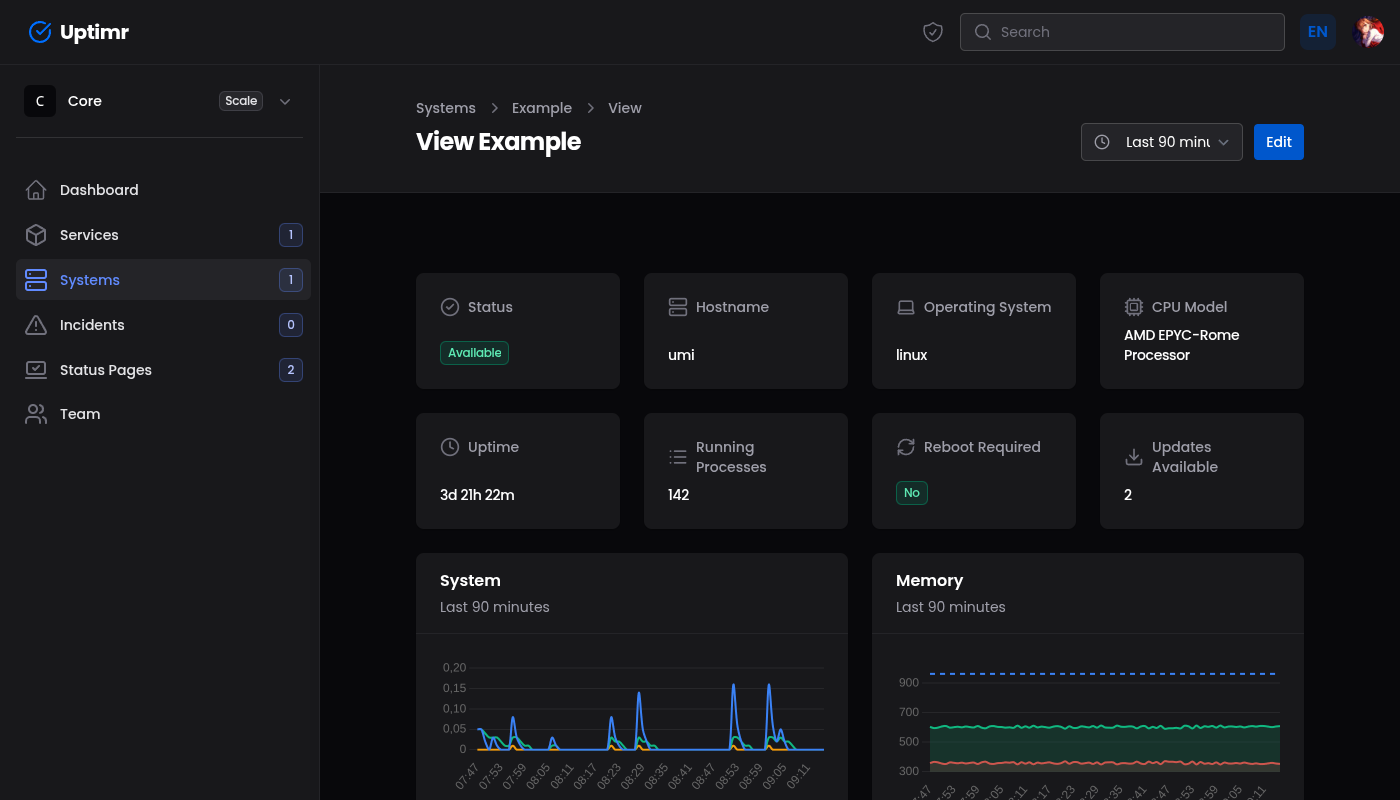
Install the lightweight Uptimr companion agent on any Linux or Windows server with a single command — no dependencies, just a static binary reporting straight back to your dashboard.
curl -fsSL https://get.uptimr.net/companion | sh
- Tracks CPU, memory, disk and network usage in real time.
- Threshold-based alerts for CPU, memory, disk, bandwidth and temperature, each with its own duration before it fires.
- Works cross-platform: the same agent ships for Linux and Windows.
- A server counts as online the moment it last reported in — no manual heartbeat configuration.
A status page customers actually trust
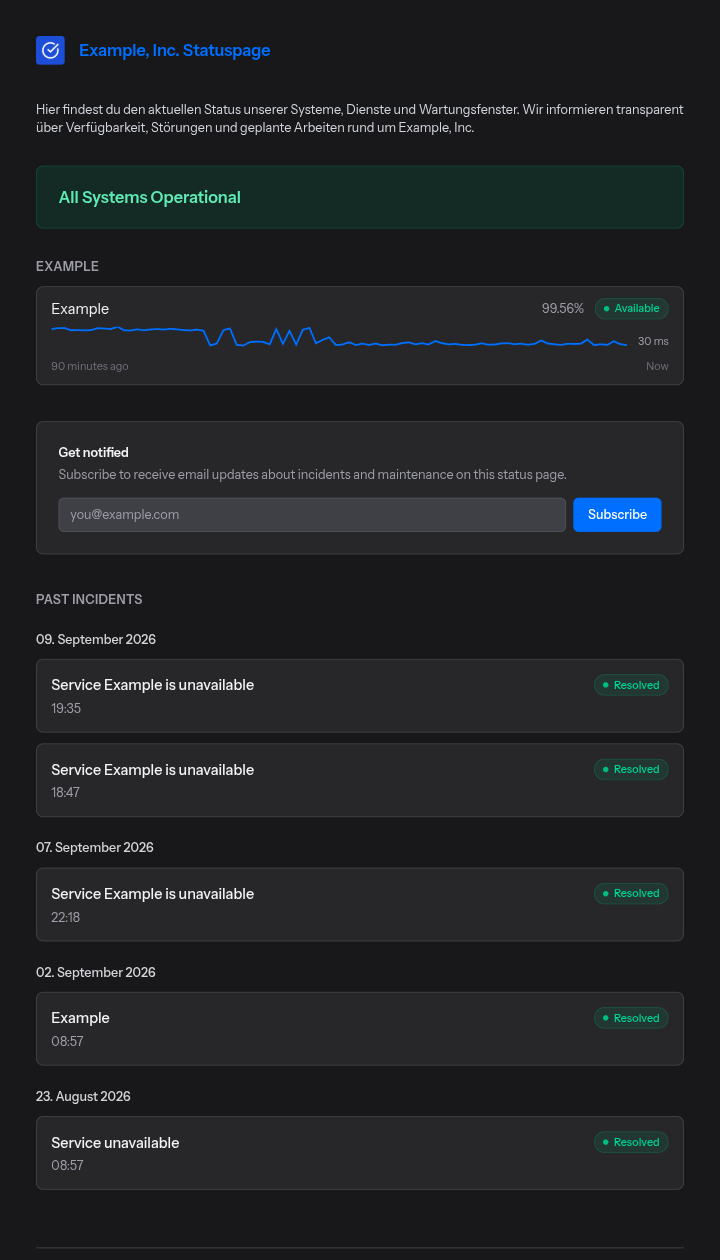
Group services, publish incident timelines and let visitors subscribe to updates — on your own domain, with your own branding.
- Public or private status pages, each with its own custom domain and free SSL.
- 90-day uptime history per service, plus live incident timelines with posts.
- Email subscribers get notified automatically when an incident is posted.
- Custom branding and white-labelling for a page that looks fully your own.
Reach the right people, on the right channel
Build reusable notification routes and attach them to any service or system — mix and match channels so the right team hears about it first.
- One notification route can fan out to email, chat and voice at once.
- Voice and SMS calls for the incidents that truly can’t wait for someone to check their inbox.
- The same routes work for service outages and system resource alerts.
A worker network that spans the globe
Checks run from independently operated worker nodes around the world, so you see real-world availability, not just uptime from one data center.
Simple plans that grow with you
Start free. Upgrade when you need faster checks, more monitors or more room to grow.
Pro
or €70 billed yearly
€7/mo
Billed annually at €70
- 50 services
- 3 systems
- 3 status pages
- Checks every 120 seconds
Scale
or €280 billed yearly
€28/mo
Billed annually at €280
- 150 services
- 10 systems
- 10 status pages
- Checks every 60 seconds
Business
or €560 billed yearly
€56/mo
Billed annually at €560
- 300 services
- 20 systems
- 20 status pages
- Checks every 15 seconds
All prices in EUR, excluding VAT. Need something bigger? Talk to us about a custom plan.
Frequently asked questions
Do I need to install anything?
Not for uptime monitoring — HTTP, keyword, ping and port checks run from Uptimr’s own worker network. You only install the lightweight companion agent on servers whose CPU, memory, disk and network you want to see, and that’s a single command on Linux or Windows.
How do you avoid false alarms?
When one location sees your service fail, Uptimr holds that result back and has another node verify it first. An incident is only opened — and your team only alerted — once the failure is confirmed.
Can I monitor cron jobs and background tasks?
Yes. A heartbeat check gives you a unique URL that your job calls each time it runs. If the ping doesn’t arrive within the expected interval plus a grace period, Uptimr treats it as down and alerts you like any other outage.
What happens during planned maintenance?
Schedule a maintenance window on the affected services. Checks inside that window are recorded as maintenance instead of downtime, and your status page shows the planned work to visitors.
Will I know before my SSL certificate expires?
Yes. Uptimr tracks the certificate expiry date of your HTTPS services and warns you ahead of time, so an expired certificate never becomes an outage.
Where is my data hosted?
Uptimr is built in Germany and hosted in the EU.
Can I start for free?
Yes — the free plan covers up to 5 10 services, one system and one status page, forever, with no credit card required. Upgrade whenever you need more monitors or faster checks.
Start monitoring in under 2 minutes
Free forever for up to 5 10 services, one system and one status page. No credit card required.
Our partners
Uptimr works with a network of technology, hosting and infrastructure partners.